NOW IN PAPERBACK!
“Powerful. . . . A heart-wrenching profile of resilience, ingenuity, and heroism.” ― Publishers Weekly
“A fine delineation of personal heroism amid an era of utter human depravity.” ― Kirkus Reviews
“Holocaust historians White and Sliwa masterfully piece together the previously untold story of a Jewish mathematician who, during the Nazi occupation of Poland, masqueraded as a countess while she helped free and feed thousands of Poles imprisoned at the Majdanek concentration camp.” ― Library Journal (starred review) THE COUNTERFEIT COUNTESS: The Jewish Woman Who Rescued Thousands of Poles During the Holocaust (Simon & Schuster, January 2024; paperback January 2025) tells the astonishing story of Dr. Josephine Janina Mehlberg—a Jewish mathematician who saved thousands of lives in Nazi-occupied Poland by masquerading as a Polish aristocrat—drawing on Mehlberg’s own unpublished memoir.
World War II and the Holocaust have given rise to many stories of resistance and rescue, but The Counterfeit Countess is unique. It tells the remarkable, unknown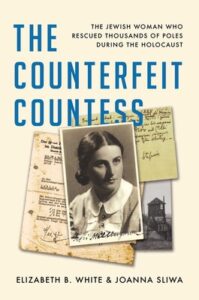 story of “Countess Janina Suchodolska,” a Jewish woman who rescued more than 10,000 Poles imprisoned by Poland’s Nazi occupiers.
Mehlberg operated in Lublin, Poland, headquarters of Aktion Reinhard, the SS operation that murdered 1.7 million Jews in occupied Poland. Using the identity papers of a Polish aristocrat, she worked as a welfare official while also serving in the Polish resistance. With guile, cajolery, and steely persistence, the “Countess” persuaded SS officials to release thousands of Poles from the Majdanek concentration camp. She won permission to deliver food and medicine—even decorated Christmas trees—for thousands more of the camp’s prisoners. At the same time, she personally smuggled supplies and messages to resistance fighters imprisoned at Majdanek, where 63,000 Jews were murdered in gas chambers and shooting pits. Incredibly, she eluded detection, and ultimately survived the war and emigrated to the US.
Drawing on the manuscript of Mehlberg’s own unpublished memoir, supplemented with prodigious research, Elizabeth White and Joanna Sliwa, professional historians and Holocaust experts, have uncovered the full story of this remarkable woman. They interweave Mehlberg’s sometimes harrowing personal testimony with broader historical narrative. Like The Light of Days, Schindler’s List, and Irena’s Children, The Counterfeit Countess is an unforgettable account of inspiring courage in the face of unspeakable cruelty. Reviews:
The remarkable story of Janina Mehlberg almost didn’t see the light of day. . . . The publication of The Counterfeit Countess is the result of the painstaking work of historical researchers and archivists who know the value of unearthing a narrative like this one, otherwise in danger of being forgotten. The result is a genuine contribution to scholarship that is also a memorable, inspiring tale of individual heroism.” — Michael S. Roth ― The Wall Street Journal
“A story of courage, compassion, and cunning so profound that it must be included with the greatest Holocaust literature. Janina Mehlberg is a heroine for the ages.” — Larry Loftis, New York Times bestselling author of The Watchmaker’s Daughter
“The Counterfeit Countess is a gripping tale of one woman’s grit and courage in the face of unimaginable terror. That it is only available today, more than fifty years after Henry Mehlberg first attempted to get it published, is a reminder of how many Holocaust stories remain untold.” — Hallel Yadin ― Jewish Book Council
“The book is part adventure-war story, part inspirational tale of right winning over might, all of it thoroughly researched. It is all the more effective for being true and being told with vibrant energy so that Janina almost steps off the page.” — Marissa Moss ― New York Journal of Books
“The Counterfeit Countess is an extraordinary testament to courage, resilience and humanity during the darkest months of the Holocaust. Beautifully crafted and meticulously researched by two of America’s powerhouse World War II historians, this riveting story will ensure that the world never forgets the utterly remarkable Josephine Janina Mehlberg and an epic rescue mission that defied great evil. You will not put this book down until the very last word — it is a stunning piece of Holocaust history that will stick with you long after you’re done.” — Debbie Cenziper, Pulitzer Prize-winning journalist and author of Citizen 865: The Hunt for Hitler’s Hidden Soldiers in America
“A stunning masterpiece of a book about a previously overlooked hero of the war and the Holocaust. Never betraying any fear, ‘Countess Suchodolska’ performed seemingly impossible miracles again and again, routinely risking her life to save thousands of Polish prisoners in the Majdanek concentration camp. Elizabeth B. White and Joanna Sliwa have performed their own miracle by meticulously reconstructing her story and giving her the long-overdue recognition she so fully deserves.“ — Andrew Nagorski, author of Saving Freud: The Rescuers Who Brought Him To Freedom
“Part biography, part adventure tale, The Counterfeit Countess is the astonishing history of “Countess Janina Suchodolska,” a heroic Polish Jewish woman who rescued thousands of Catholic Poles during the Holocaust. Historians Elizabeth White and Joanna Sliwa turned sleuths as they painstakingly pieced together the story of her wartime activities from shards of information scattered across archives in Europe and North America. A riveting account of moral courage and an enduring commitment to save lives.” — Debórah Dwork, director, Center for the Study of the Holocaust, Genocide, and Crimes Against Humanity, The Graduate Center―City University of New York
About the Authors
Dr. Elizabeth “Barry” White recently retired from the United States Holocaust Memorial Museum, where she served as historian and as Research Director for the USHMM’s Center for the Prevention of Genocide. Prior to working for the USHMM, Barry spent a career at the US Department of Justice working on investigations and prosecutions of Nazi criminals and other human rights violators. She served as deputy director and chief historian of the Office of Special Investigations and as deputy chief and chief historian of the Human Rights and Special Prosecutions Section. She lives in Falls Church, Virginia.
Dr. Joanna Sliwa is a historian at the Conference on Jewish Material Claims Against Germany (Claims Conference) in New York, where she also administers academic programs. She previously worked at the American Jewish Joint Distribution Committee, and at the Museum of Jewish Heritage—A Living Memorial to the Holocaust. She has taught Holocaust and Jewish history at Kean University and at Rutgers University and has served as a historical consultant and researcher, including for the PBS film In the Name of Their Mothers: The Story of Irena Sendler. Her first book, Jewish Childhood in Kraków: A Microhistory of the Holocaust won the 2020 Ernst Fraenkel Prize awarded by the Wiener Holocaust Library. She lives in Linden, New Jersey.

 bone, providing structure, support and stability. (World English, Johns Hopkins University Press, Spring 2026)